|
|
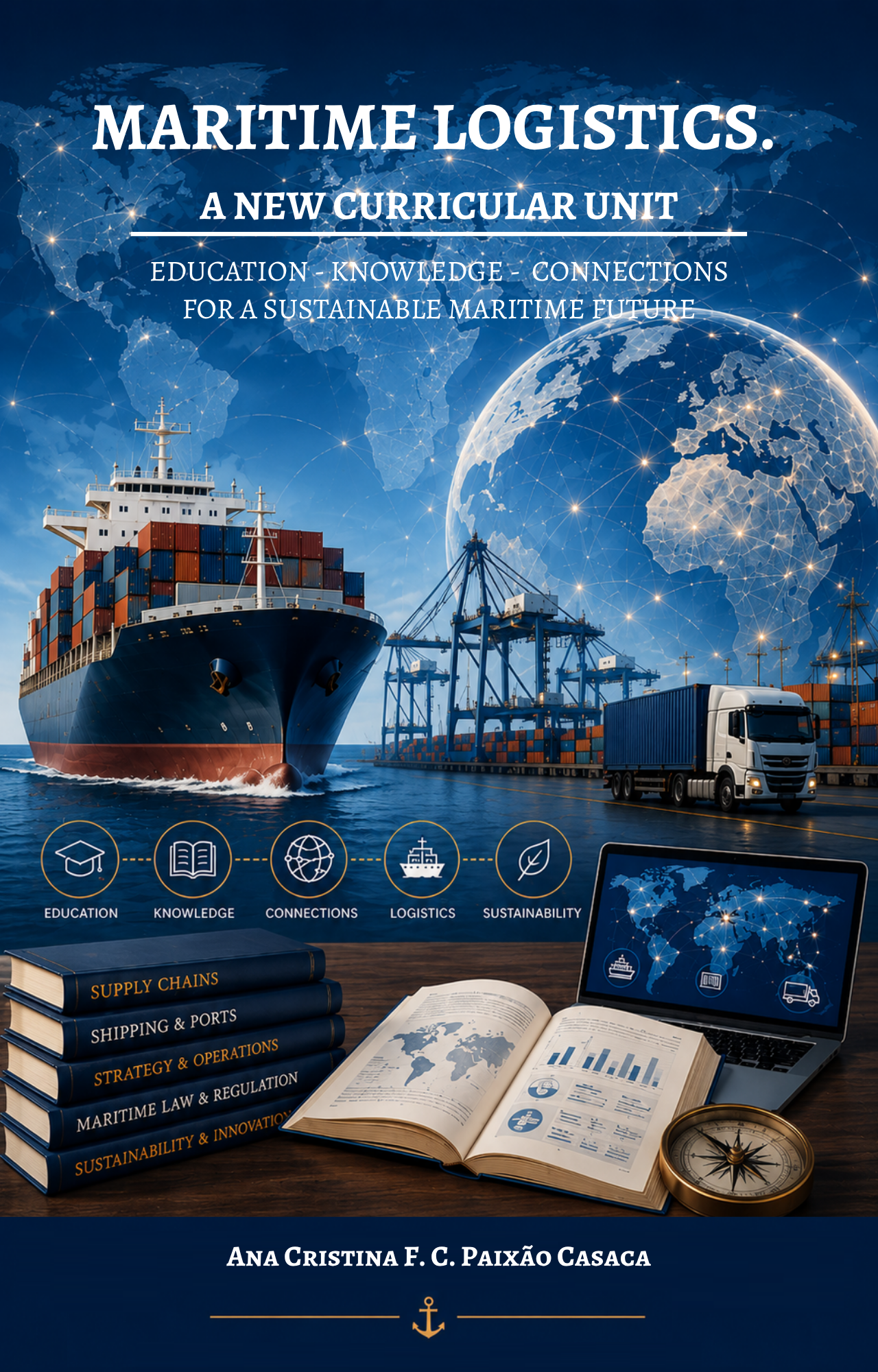
| MARITIME LOGISTICS. A NEW CURRICULAR UNIT |
| |
| |
Ana Cristina Ferreira Castela Paixão Casaca, ‘World of Shipping Portugal’, Parede, Portugal and CIMOSM - Centro de Investigação em Modelação e Optimização de Sistemas Multifuncionais, ISEL, 1959-007 Lisboa, Portugal.  https://orcid.org/0000-0003-3925-473X https://orcid.org/0000-0003-3925-473X |
| |
| |
| |
| SUMMARY |
| The increasing complexity of global trade, rapid technological advancement, growing sustainability imperatives, and heightened geopolitical uncertainty have significantly expanded the role of maritime logistics within international transport and supply chain management. Despite its strategic importance, Maritime Logistics remains inconsistently represented within higher education, often appearing as isolated topics within broader programmes rather than as a distinct academic discipline. This study examines the current educational landscape of maritime logistics and proposes a comprehensive curricular framework capable of addressing contemporary industry requirements. |
| The research adopts a qualitative review methodology, analysing university programmes, individual subjects, professional courses, workshops, and international knowledge networks related to maritime logistics. The review identifies the extent to which maritime logistics is taught across undergraduate, postgraduate, diploma, and executive education, while also evaluating the contribution of professional associations and collaborative networks to knowledge dissemination and lifelong learning. The findings reveal considerable diversity in educational provision but also demonstrate the absence of a coherent and comprehensive curricular structure dedicated exclusively to maritime logistics. |
| Building upon the results of the review, the study critically examines the conceptual foundations of maritime logistics by exploring its relationship with logistics, supply chain management, strategic logistics, shipping as a service supply chain, and Porter's Value Chain Model. This analysis establishes clear conceptual boundaries for maritime logistics and proposes a definition that reflects its multidisciplinary character and strategic role within the global maritime industry. |
| The principal contribution of this work is the development of a new Maritime Logistics syllabus designed as a standalone university curricular unit. Structured in accordance with the Agência de Avaliação e Acreditação do Ensino Superior (A3ES) curricular unit model, the proposed syllabus integrates shipping industry fundamentals, maritime operations, logistics management, ancillary logistics systems, and industry-based case studies into a coherent learning framework. The syllabus is supported by clearly defined learning outcomes, teaching methodologies, assessment strategies, and recommended bibliography, ensuring alignment with competency-based higher education principles and current industry expectations. |
| The proposed curricular unit seeks to bridge the gap between academic provision and professional practice by adopting an interdisciplinary approach that combines maritime transport, logistics, supply chain management, port operations, international trade, digitalisation, sustainability, risk management, and strategic decision-making. It aims to equip future maritime professionals with the analytical, managerial, and practical competencies required to operate effectively within increasingly complex, technology-driven, and globally interconnected maritime supply chains. Ultimately, this study contributes to the recognition of Maritime Logistics as a distinct field of study and provides a reference framework for universities seeking to develop or modernise maritime logistics education. It is anticipated that the proposed syllabus will support greater consistency in curriculum development, strengthen collaboration between academia and industry, and contribute to preparing graduates capable of addressing the challenges and opportunities facing the maritime sector in the twenty-first century. |
| |
| KEYWORDS |
| Maritime Logistics; Maritime Transport; Shipping; Supply Chain Management; Logistics Education; Higher Education; Curriculum Development; Maritime Supply Chains; Port Logistics; Transport Management. |
| |
| |
| |
|
| |
| |
| |
| INSTITUTIONAL PRESENTATION |
| |
| A live 2-hour online institutional presentation is available via Zoom for universities, maritime academies, training providers, and corporate organisations wishing to evaluate the discipline and its implementation. |
| Institutional Presentation Fee: €750 (plus VAT, where applicable). |
| The presentation includes: |
| An overview of the discipline and its learning outcomes. |
| A review of the detailed syllabus and accompanying notes. |
| Guidance on institutional implementation. |
| A live question-and-answer session. |
|
| |
| INTELLECTUAL PROPERTY NOTICE |
| |
| The presentation and all accompanying materials are protected by copyright and other intellectual property rights. |
| Participants are strictly prohibited from recording, photographing, screenshotting, filming, livestreaming, downloading, copying, reproducing, transcribing, sharing, distributing, or otherwise capturing any part of the presentation or its contents by any means, whether electronic, digital, mechanical, or otherwise, without the prior written consent of the author. |
| Attendance at the presentation constitutes acceptance of these conditions. |
| Should an institution decide to proceed with an annual institutional licence, the presentation fee may, at the author's discretion, be credited towards the licence fee. |
| |
| |
| |
| SECURE YOUR 12-MONTH INSTITUTIONAL LICENCE |
| |
| The discipline is introduced through a mandatory paid online institutional presentation conducted via Zoom. |
| Following the presentation, institutions may obtain a 12-month Institutional Licence, which provides secure access via the Moodle platform to the protected PDF documents comprising the detailed syllabus and accompanying notes. |
| The licence authorises the institution to implement and teach the discipline for one academic year from the date the licence is granted. Lecturers employed or authorised by the licensed institution may use the intellectual content of the licensed materials to prepare and deliver teaching within that institution. |
| Ownership of all intellectual property remains exclusively with the author. The licence grants a limited right to use the content for teaching purposes only and does not transfer ownership or grant any right to reproduce, modify, publish, distribute, sublicense, commercially exploit, or create derivative teaching materials based on the licensed documents. |
| The protected PDF documents and any associated materials may not be downloaded, copied, reproduced, printed, recorded, photographed, screenshot, scanned, shared, transmitted, distributed, or otherwise redistributed, in whole or in part, without the prior written consent of the author. |
| Upon expiry of the 12-month licence period, access to the Moodle platform and all licensed materials will cease unless the Institutional Licence is renewed. |
| |
| |
| |
| BOOK YOUR INSTITUTIONAL PRESENTATION |
| |
|
| |
| Top of the page |
| |
|
|