|
|
| |
| The Evolution of Containerisation from 1770s to 2030. Part 2 |
| |
| Written by Ana Casaca |
Posted on 17 June 2025 | Updated on 16 March 2026 |
Reading Time 57 minutes |
|
 |
| |
| Part 1 of this work has traced the long arc of freight evolution, beginning with pre-industrial practices where cargo was moved as loose items, often handled laboriously piece by piece. The Industrial Revolution marked a significant turning point, introducing palletisation and mechanised handling, allowing for greater efficiency and laying the groundwork for further innovation. The drive to simplify transfers between rail, road, and sea early in the twentieth century gave rise to the first intermodal concepts. The American lift van, British experiments, and continental European developments in rail-based containerisation were pivotal, yet these early efforts were hampered by limited scale and lack of standardisation. As the interwar period prompted infrastructure and institutional adaptation, fundamental barriers persisted. It was not until World War II, with the introduction of the CONEX box for military logistics, that containerised freight's practical and strategic value became undeniable. Though immediate in impact, the CONEX system’s influence on civilian transport still left much potential unrealised. Part 2 will pick up this narrative at the threshold of commercial breakthrough, focusing on Malcom McLean’s transformative vision, the first standardised container voyage, the development of global standards, and the remarkable expansion and technological progression that turned containerisation into the backbone of international trade. |
| ********************************* |
| |
5. The Commercial Breakthrough of Containerisation and Malcom McLean’s Contribution |
| While early experiments in intermodal freight, ranging from railway containers in Europe to military innovations such as the CONEX box, demonstrated the conceptual viability of containerised logistics, it was not until the 1950s that containerisation achieved its commercial breakthrough. This was largely due to the visionary leadership of Malcom McLean, whose systematic integration of containers into commercial maritime operations redefined the global shipping industry. McLean transformed a promising logistical concept into a revolutionary global system through standardisation, innovation, and strategic investment. |
| |
| 5.1. Malcom McLean: From Trucking Entrepreneur to Shipping Pioneer |
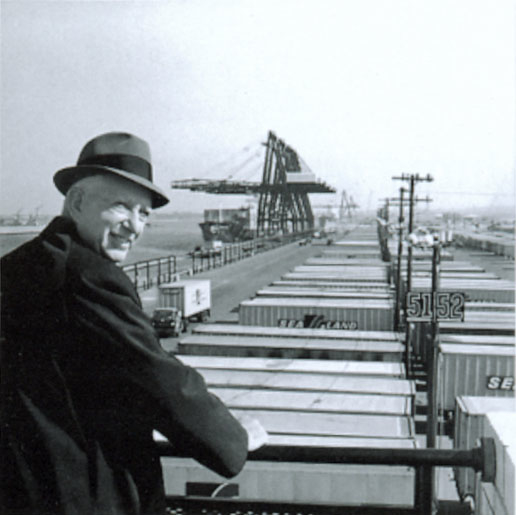
| Malcom Purcell McLean’s (see Figure 7) transformation from a regional trucking entrepreneur to a visionary architect of global logistics is one of the most consequential chapters in the history of modern trade. Born in 1913 in North Carolina, McLean began his career modestly, founding a small trucking company in the 1930s during the Great Depression. With tenacity, operational acumen, and a strong work ethic, he gradually expanded his enterprise, McLean Trucking Company, into one of the largest and most efficient freight hauliers in the United States by the early 1950s. However, McLean’s ambitions extended far beyond the highways of America. |
| |
| Figure 7: Malcom McLean in 1957 |
 |
| Source: Wikipedia (2025) |
| |
| Through his extensive involvement in overland freight distribution, McLean encountered firsthand the chronic inefficiencies of the breakbulk cargo system, the dominant method for loading and unloading goods at ports. In 1937, while delivering cotton bales from North Carolina (Lafayette) to New York Harbor, McLean was forced to wait several days while dockers manually loaded the cargo. He observed how dockers painstakingly moved individual items, crates, barrels, and sacks from truck beds to dockside warehouses and then onto ships, a slow process prone to damage, loss, theft, and high labour costs. As a businessman who had already optimised trucking efficiency, McLean realised that the actual logistical bottleneck in freight movement lay at the interface between land and sea transport: the port terminal. |
| This realisation gave rise to his revolutionary insight to radically reduce cargo handling by moving goods in pre-packed units that could remain sealed from the point of origin to the final destination. Rather than unloading truck cargo piece by piece at the dock, McLean envisioned lifting the entire truck trailer or the cargo container directly onto the ship. This would preserve cargo integrity, slash port turnaround times, and lower total logistics costs by reducing labour and handling errors. At the time, however, this idea defied conventional thinking in the maritime industry, where deeply entrenched breakbulk practices had remained unchanged for decades. |
| Facing regulatory obstacles, notably the United States laws that prohibited direct ownership of both trucking and shipping assets to prevent monopolistic practices, McLean made a pivotal strategic decision. In 1955, he sold his stake in McLean Trucking for $6 million and used the capital to purchase the Pan-Atlantic Steamship Company, a small, underutilised coastal shipping line. He soon renamed it Sea-Land Service and redirected its mission: to become the world’s first fully containerised shipping company. McLean’s vision was no longer about improving a single mode of transport but creating the first integrated, multimodal freight system in which containers could move seamlessly between trucks, trains, and ships without ever being unpacked. |
| From this point forward, McLean committed to turning a disruptive idea into an industrial reality. He invested in the design of standardised containers that were strong, weatherproof, and capable of being lifted by cranes and stacked efficiently on ships. He commissioned retrofits of tankers, such as the Ideal X, to accommodate container loads and led the construction of specialised container terminals equipped with new handling equipment and layout designs tailored to the needs of intermodal cargo. His approach was not merely technological; it was systemic. He understood that for containerisation to succeed, it required harmonising infrastructure, equipment, procedures, and regulatory frameworks across the entire transport ecosystem. |
| McLean’s relentless pursuit of efficiency, standardisation, and scale laid the groundwork for a transport model to revolutionise global trade. His work transformed what had once been a fragmented, error-prone supply system into a streamlined, high-throughput, low-cost global network. In doing so, McLean did not just innovate in shipping; he reshaped the economics of production and distribution worldwide. Thus, Malcolm McLean’s legacy lies in his invention of the modern shipping container and his systemic vision of freight transport as an interconnected, standardised, and scalable architecture. His journey from trucking to shipping represents a rare fusion of practical experience, strategic foresight, and entrepreneurial daring, qualities that earned him recognition as one of the most significant logistics innovators of the 20th century. |
| |
| 5.2. The First Container Voyage: 1956 |
| On April 26, 1956, a seemingly routine maritime journey became a transformative moment in the history of global logistics. The Ideal X, a converted World War II T2 oil tanker, set sail from Port Newark to Houston on 26 April 1956, carrying 58 uniform steel containers, each 33 feet in length, and approximately 15,000 tons of bulk petroleum, marking the first successful commercial application of intermodal container shipping. Though modest in appearance, this voyage marked the actual birth of commercial container shipping, a disruptive innovation that would, in time, reshape the global economy. The Ideal-X was not a container ship in the modern sense but had been retrofitted with strengthened decks to carry containers above rather than below deck. The containers had been preloaded at inland origin points onto truck chassis, then sealed and transported to the port, where they were lifted intact onto the ship using cranes. This seemingly simple adjustment, avoiding the need to unpack and reload cargo at every transport node, represented a profound departure from centuries of cargo handling practice. |
| The success of the voyage was immediate and undeniable. McLean’s key hypotheses were validated in real-world conditions. Loading and unloading times were dramatically reduced, shifting from the standard of multiple days required to handle breakbulk cargo to a matter of hours; this had enormous implications for port congestion, ship scheduling, and freight throughput. Labour costs plummeted. Where breakbulk cargo required hundreds of dockworkers to load and unload individual items manually, container handling could be done by a handful of operators using cranes and forklifts; this reduced costs and minimised the risks of human error and injury. Cargo security improved significantly. The sealed steel containers protected goods from theft, pilferage, water damage, and contamination, which were common risks in open cargo holds or with loosely packed breakbulk shipments; this elevated the trust and predictability of shipping, particularly for high-value or sensitive goods. Turnaround times at port dropped sharply, increasing vessel utilisation and fleet productivity. Ships could spend more time sailing and less time docked, a critical advantage in an industry where asset utilisation is a significant cost driver. |
| Though the Ideal-X carried just 58 containers, its journey’s symbolic and practical significance cannot be overstated. It was the first visible step in creating a new global logistics system characterised by modularity, speed, security, and intermodality. In the following years, Malcom McLean’s Sea-Land Service would build on this momentum, developing purpose-built container ships, establishing container terminals, and promoting international standards that would culminate in the ISO container. The Ideal-X’s voyage proved that the age-old logistics problem of fragmented, slow, and labour-intensive cargo movement could be solved not through incremental change but through a revolution in form, function, and thinking. |
| |
| 5.3. Global Standardisation and the ISO Container: The Key to Interoperability |
| Malcom McLean’s pioneering contribution to containerisation extended far beyond his engineering and entrepreneurial achievements. One of his most profound insights was that the real power of the container did not lie merely in its physical form but in its standardisation. Without uniformity in container dimensions, structure, and handling features, the promise of global, multimodal logistics would remain fragmented and inefficient. McLean understood that true interoperability between ships, ports, trucks, trains, and terminals depended on creating a common technical language for containers. |
| The early years of containerisation were marked by diverse proprietary designs, with different shipping companies experimenting with various formats, sizes, lifting points, and locking mechanisms. This design heterogeneity posed significant operational challenges. Equipment incompatibilities led to delays, inefficient cargo handling, and duplicated infrastructure investments. The advantages containerisation promised, such as speed, scalability, and seamless modal integration, were threatened by this lack of cohesion. The early years of containerisation were marked by competing designs, formats, and engineering philosophies. Different shipping companies experimented with various container sizes and lifting mechanisms, leading to operational inconsistencies and infrastructure incompatibilities. This lack of uniformity threatened to undermine the advantages that containerisation promised, namely, speed, scalability, and seamless modal transfer. McLean recognised that the industry would remain mired in costly duplication and inefficiency unless a single set of machines, dockside cranes, chassis, and railcars could universally handle containers. |
| To address this, McLean leveraged his company, Sea-Land Service, as an industry leader and a testing ground for prototype standards. Working closely with United States government agencies, including the Department of Defense, which had a vested interest in containerised military logistics, port authorities and freight terminal operators, McLean became a vocal proponent of a global harmonisation process. His efforts galvanised the American Standards Association (ASA) to develop national container standards, which would later form the foundation for international protocols. By the mid-1960s, formal negotiations with the ISO were underway, resulting in the landmark ISO container standards by the decade’s end, which codified the dimensions and tolerances of these fittings, ensuring compatibility across handling equipment globally. Together, they established a harmonised global framework that transformed the container into a truly modular and interoperable logistics asset and marked a critical turning point in the evolution of containerisation and the global logistics system. They addressed the following important aspects: |
| |
- Dimensional Uniformity (ISO 668): ISO 668 is the international standard that defines the external dimensions and tolerances for series one freight containers, including the widely used twenty-foot equivalent unit (TEU) and forty-foot equivalent unit (FEU). This standard ensures that containers can be handled, stacked, and transported interchangeably across ships, trucks, and trains worldwide, providing the foundation for container modularity and capacity measurement. The TEU (20’ x 8’ x 8.5’) became the fundamental metric for measuring capacity, while the FEU gained traction on long-haul routes due to its volume efficiency.
|
- Corner Castings and Fittings (ISO 1161): ISO 1161 specifies the design and placement of corner fittings (castings) on freight containers. These fittings are critical for safe handling: they allow containers to be lifted by cranes, secured with twist-locks on vessels and railcars, and attached to truck chassis. Standardised corner castings ensure interoperability and safety across all modes of container handling.
|
- Structural Integrity Standards (ISO 1496): While ISO 668 and ISO 1161 focus on dimensions and fittings, ISO 1496 covers structural requirements like strength, durability, and weather resistance, ensuring containers withstand stacking, lifting, and repeated use in harsh environments. Containers are thus designed to endure repeated use across transport modes, reducing long-term costs and improving sustainability.
|
- Container Classification, Coding, and Identification (ISO 6346): ISO 6346 establishes the system for marking, coding, and identifying containers. It specifies the format for container identification numbers (owner code, equipment category, serial number, and check digit), country codes, size and type codes (so you know what type and dimensions a container has at a glance) and operational marks (such as maximum gross weight). This standard allows containers to be uniquely identified, traced, and classified worldwide, supporting global tracking, inventory management, and safety and regulatory requirements compliance.
|
|
| |
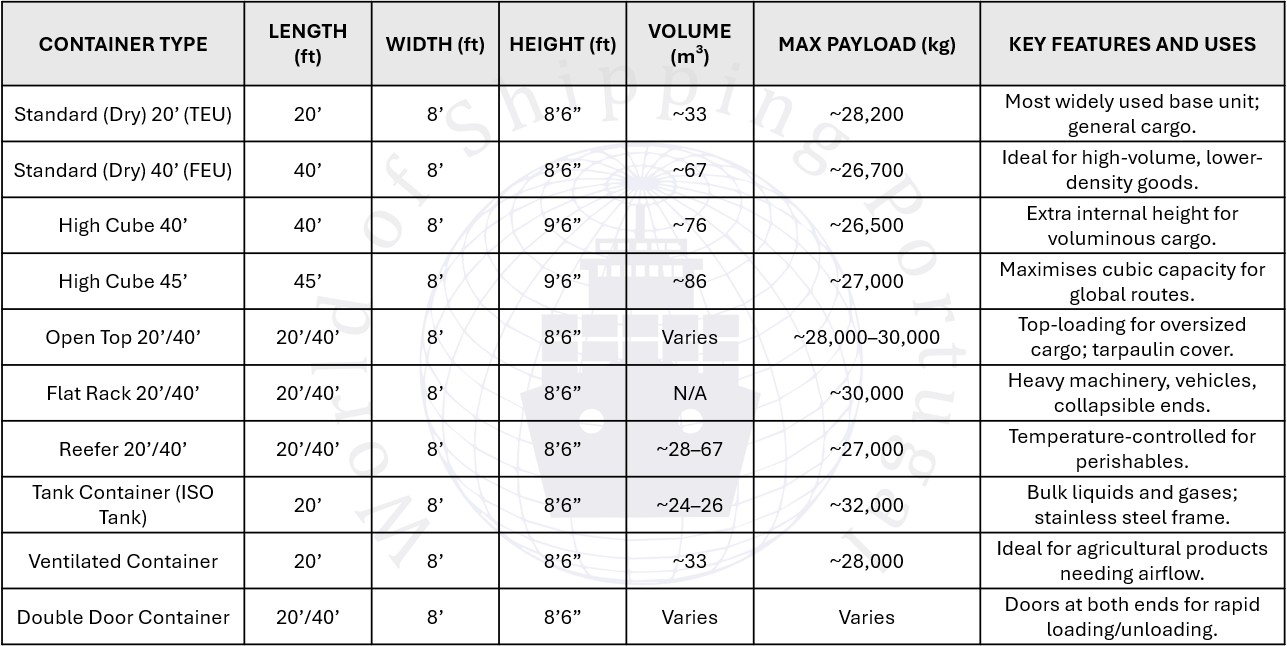
| Table 1: ISO Standard Containers: Types, Dimensions, and Features |
 |
| Source: Paixão Casaca (2025) |
| |
| This harmonisation laid the technical foundation for intermodalism, the seamless movement of goods across sea, rail, and road without repacking. A container loaded in a textile factory in Vietnam could travel by truck to a port, be shipped across the Pacific, transferred onto a train in California, and reach a distribution centre in Chicago without ever being opened. This interoperability allowed all supply chain nodes and arcs to be engineered around a single, standardised unit. The result was a dramatic reduction in handling times, the elimination of repacking inefficiencies, and the reliable coordination of multimodal flows. The universalisation of container types under ISO compliance, from dry vans to reefers, flat racks, and ISO tanks, enabled a broad range of cargoes to move under unified protocols. With over 90% of non-bulk global trade now containerised, their widespread use attests to their infrastructural importance. This standardisation enabled ports to invest in mechanised infrastructure built around predictable specifications, shipping lines to design vessels optimised for TEU capacity, and inland transport operators to align chassis and rail wagons to a standard format. Table 1 presents the ISO Standard containers, types, dimensions, and features. |
| From a macroeconomic perspective, this was not merely a technical achievement but a strategic enabler of globalisation. Standardisation reduced transport costs and enhanced reliability, allowing firms to restructure supply chains to leverage labour arbitrage, resource proximity, and just-in-time production models. It facilitated offshore manufacturing in Asia, developing inland logistics hubs in consumer markets and seamlessly integrating global trade corridors. Like standardised electrical outlets or rail gauges in previous industrial eras, ISO container standards enabled network effects to take hold across the global economy. The result was the industrialisation of global logistics and the creation of a logistics architecture upon which modern commerce depends. McLean’s push for standardisation was a technical exercise and a strategic act of system-building, enabling containerisation to evolve from a Sea-Land innovation into a universally adopted infrastructure. In doing so, he secured the shipping container’s place as the silent, stackable engine of the 21st-century global economy. |
| |
| 5.4. Global Expansion and Industry Adoption |
| By the early 1960s, the demonstrable success of Malcom McLean’s containerisation model, pioneered through Sea-Land Service, triggered a wave of interest, investment, and innovation across the global maritime and logistics industries. What began as a disruptive United States-based initiative quickly evolved into a worldwide transformation of how cargo was handled, transported, and traded. Recognising the efficiency gains, cost reductions, and logistical reliability enabled by containerisation, shipping companies, port authorities, and governments worldwide began reconfiguring their infrastructure and operations to accommodate the new paradigm. |
| A pivotal moment in containerisation’s global expansion was the launch of regular transatlantic container services in 1966 when Sea-Land initiated scheduled routes between New York and major Northern European ports. This marked the first application of containerisation in long-haul international trade and proved that the model was viable on domestic or short-sea routes and across complex, intercontinental supply chains. European ports such as Bremen, Rotterdam, and Liverpool quickly began constructing dedicated container terminals to meet this new operational standard, laying the groundwork for transatlantic trade efficiency that outpace traditional breakbulk shipping in cost and speed. |
| Another key milestone came through the United States military’s strategic use of containerisation during the Vietnam War from 1955 to 1975. Sea-Land was awarded a substantial contract to deliver military supplies to Southeast Asia using containers. The war zone presented a high-pressure environment with significant logistical complexity, harsh climates, limited infrastructure, and the constant threat of conflict. Containerisation proved ideal: pre-packed, sealed containers could be moved rapidly from American depots to ports in Vietnam with minimal handling, dramatically improving reliability, reducing theft and damage, and lightening the burden on overstretched port personnel. The military’s success with container logistics in Vietnam served as a large-scale, real-time validation of the system’s scalability, adaptability, and resilience, reinforcing its value in commerce and complex, mission-critical operations. |
| As adoption expanded, global port cities began transforming into container hubs, redefining their economic roles and physical geographies. Ports such as Rotterdam, Singapore, Hong Kong, and Oakland underwent a substantial redesign to accommodate massive container throughput. These cities became pioneers of terminal automation, intermodal connectivity, and cargo tracking systems, evolving into strategic nodes of the emerging global logistics network. The transformation went beyond dockside operations: entire hinterland transport corridors, industrial parks, and logistics clusters developed around these container ports, facilitating trade-driven urbanisation and economic growth. |
| By the late 1960s and early 1970s, major shipping lines such as Maersk, Hapag-Lloyd, NYK Line, and Mitsui O.S.K. Lines had begun developing container fleets and global terminal partnerships. Recognising the competitive advantages of container shipping, faster turnaround, lower labour intensity, higher cargo security, and economies of scale, they integrated container services into their long-haul and regional routes. This marked the true industrialisation of container transport, with growing alliances and consortia seeking to share infrastructure, coordinate schedules, and standardise practices across borders. |
| Containerisation’s global adoption was not merely a technological diffusion but a restructuring of global trade infrastructure and logistics governance. It required the harmonisation of customs procedures, the development of international handling codes, and the adoption of digital tracking systems, further accelerating the shift toward container-based systems. By the mid-1970s, containerisation had moved from early adoption to global normality, becoming the foundation upon which modern supply chains and, by extension, globalisation would be built. |
| Containerisation radically accelerated the velocity and reliability of goods movement, making modern global supply chains viable and efficient. By shifting from fragmented, unpredictable breakbulk operations to tightly scheduled container movements, firms could better coordinate production, inventory, and distribution. This development enabled just-in-time and lean manufacturing models, where inventory minimisation depends on reliable, frequent deliveries. Without container-based logistics, the precision and flexibility demanded by these models would be impossible at scale. |
| Moreover, the container empowered emerging markets by reducing the cost and complexity of engaging in international trade. With container ports established across Asia, Latin America, and Africa, developing countries gained access to global markets for both exports and imports. Containerisation thus catalysed globalisation, enabling production to be fragmented across borders and economies to be integrated into a global trading system. It enabled the rise of global manufacturing hubs such as China, Vietnam, and Mexico and allowed Western firms to decentralise production while maintaining control over supply chain timelines and costs. |
| |
6. The Transition to Global Containerisation (1970s and Beyond) |
| The introduction of the standardised shipping container fundamentally reshaped the architecture of global logistics by enabling a scalable, modular system that could be universally adopted across transport modes and geographies. Once formalised under ISO guidelines, containers rapidly became the universal currency of freight movement, interchangeable, stackable, and traceable units capable of seamless transfer from ship to shore, rail to road, and warehouse to distribution centre. This modularity unlocked unprecedented coordination and interoperability throughout the global supply chain, laying the foundation for a logistical revolution. Standardisation produced far-reaching effects across all prominent transport actors, including shipping lines, ports, and rail and road operators. Harmonisation led to a substantial leap in logistics performance, as time-consuming and error-prone practices, such as cargo repacking, trans-loading, and manual inventory checks, were eliminated or significantly reduced. As a result, the entire logistics chain became faster, more predictable, and considerably less labour-intensive. |
| Pioneering companies such as Sea-Land, Matson Navigation, Grace Line, and later global giants like Maersk were instrumental in driving this infrastructure overhaul. These early adopters made bold capital investments in ships, ports, and inland networks, often accepting significant upfront risks to secure long-term strategic advantage. Their initiatives established the economic rationale of containerisation: a dramatic reduction in cost per ton-mile, increased cargo security, and far greater predictability in delivery schedules. These improvements enabled logistics managers to implement tighter delivery windows, more efficient inventory management, and just-in-time production models across industries. By replacing fragmented, labour-intensive systems with integrated, mechanised infrastructure, containerisation did not merely accelerate trade; it fundamentally redefined the global transport landscape. The transformation of ports, ships, and inland transport systems turned the humble container into a cornerstone of global commerce, enabling goods to move faster, more cheaply, and with greater reliability than before. In effect, infrastructure transformation was not simply a consequence of containerisation; it was both its enabling condition and its most enduring legacy. |
| Crucially, the advent of containerisation was not simply a matter of introducing standardised cargo units; it required a complete transformation of global freight transport infrastructure. The successful adoption of containerised logistics demanded a comprehensive reengineering of physical assets, operational workflows, and regulatory frameworks across the supply chain. Moreover, this harmonisation led to a substantial leap in logistics performance. Time-consuming and error-prone practices, such as cargo repacking, trans-loading, and manual inventory checks, were eliminated or minimised. As a result, the entire logistics chain became faster, more predictable, and significantly less labour-intensive. Beyond operational efficiency, the advent of modular logistics supported a fundamental reorganisation of global production systems. Firms could now design supply chains around container flow, making it viable to source components from geographically distant suppliers and consolidate manufacturing in locations with lower labour costs or favourable trade conditions. The reduced cost and increased reliability of container shipping enabled: |
| |
- The offshoring of manufacturing to East and Southeast Asian countries became hubs for global production due to their competitive cost structures and growing industrial capabilities.
|
- The emergence of just-in-time and lean production models, which relied on precise delivery schedules and minimal inventory holdings. The container’s predictability enabled firms to coordinate deliveries with production timelines, reducing storage costs and improving cash flow.
|
- The development of inland logistics hubs, such as dry ports, freight villages, and intermodal terminals, could efficiently consolidate or disperse container traffic between seaports and regional markets. These inland nodes became crucial extensions of the maritime logistics chain, facilitating broader market reach and reinforcing the container’s role as a global logistics enabler.
|
|
| |
| By the close of the 1970s, the ISO container had become the lingua franca of global trade logistics. This shared standard enabled transport systems, industries, and national economies to interconnect with unprecedented fluidity, effectively dissolving many traditional barriers to international trade. The impact of containerisation extended far beyond mere transport efficiency; it fundamentally transformed the spatial logic of trade, reinforced the emergence of global value chains, and laid the foundation for today’s hyper-connected world economy. The scale of this transformation is perhaps most vividly illustrated by the explosive growth in container traffic over the subsequent decades. In 1980, global container throughput was estimated at around 36 million TEUs. By 2020, this figure had surpassed 800 million TEUs, a staggering increase of over 2,100%. This enormous surge in container movement now supports trillions of dollars in merchandise trade annually. It underpins the modern consumer economy, where goods are sourced, produced, and delivered globally, often just in time to meet demand. In response, ports, shipping lines, rail operators, and logistics providers have evolved into a finely tuned, responsive global network capable of dynamically adapting to shifts in demand, production patterns, and geopolitical risk. The result is not only a revolution in transport efficiency but a structural transformation of global commerce, one in which the ISO container stands as both the symbol and the engine of unprecedented economic interconnection. However, before all this impact on the world trading system, the maritime industry underwent and is still undergoing different evolutionary stages, the impact of which extended to the whole transport chain. The following paragraphs address these evolutionary stages. |
| |
| 6.1. The Rise in Containership Size: Scaling the Seas |
| The evolution of containership size is among the most conspicuous and transformative developments in the history of containerisation. As global trade volumes surged from the 1970s onwards, shipping companies responded by investing in successively larger vessels capable of transporting thousands, and eventually tens of thousands, of containers on a single voyage. This trend towards ship enlargement was not a linear escalation in capacity; instead, it represented a complex interplay of engineering innovation, economic imperatives, regulatory adaptation, and logistical coordination. The origins of this trajectory can be traced to the pioneering efforts of Malcom McLean and the first voyage of the converted oil tanker Ideal X in 1956. Early container shipping relied on retrofitted vessels, general cargo ships and tankers equipped with reinforced decks and guide rails to carry containers. However, these initial adaptations soon revealed significant capacity, safety, and efficiency limitations, spurring the development of purpose-built containerships. |
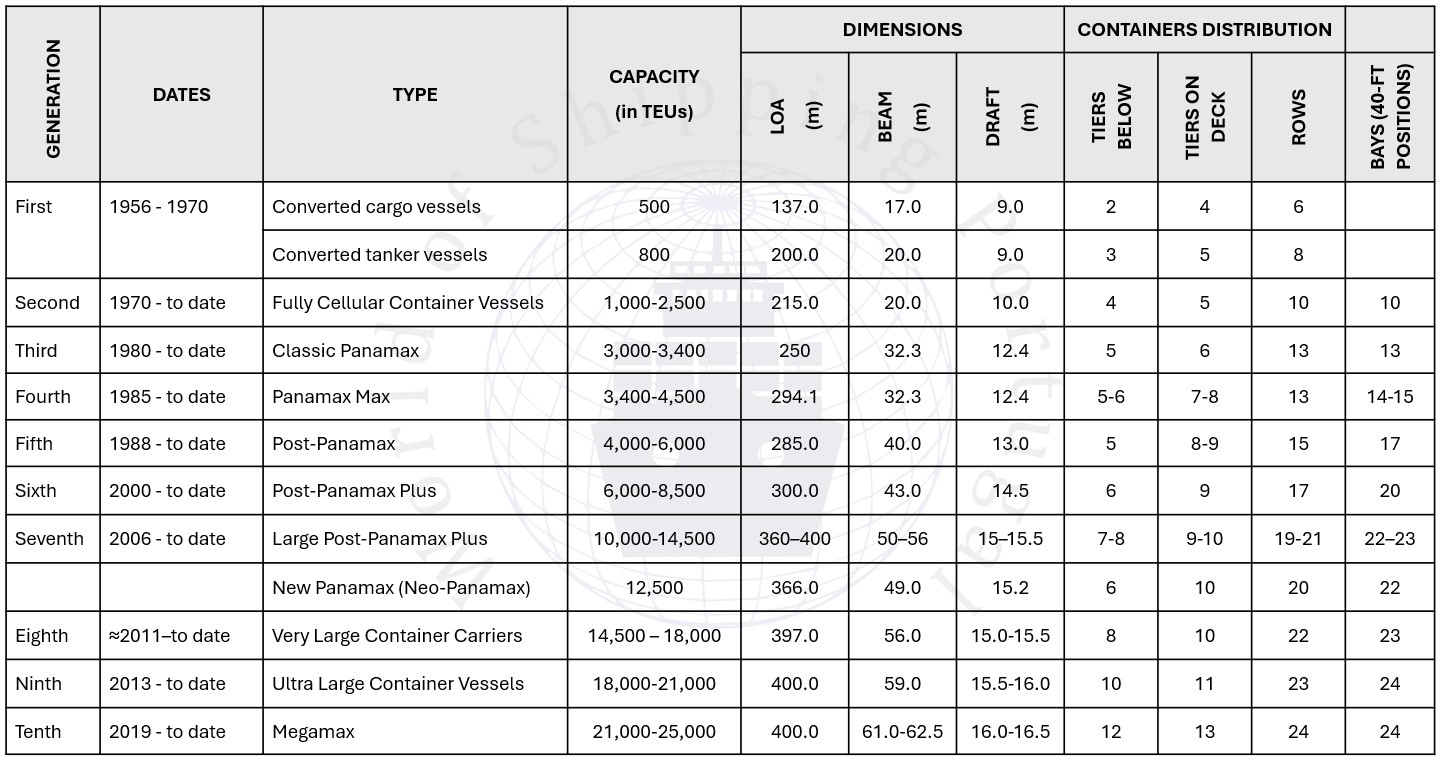
| The introduction of the cellular containership, featuring open bays with vertical guide cells specifically designed to hold stacked containers, marked a critical innovation. These vessels offered greater cargo density, improved stability, and allowed for the rapid mechanised loading and unloading that became hallmarks of the container era. Moreover, the uniform container dimensions have allowed ship designers to optimise slot configurations, enhance vessel stability, and streamline stowage planning. The increased predictability of cargo handling has enabled more effective voyage management, supporting the just-in-time logistics on which global supply chains depend. As container shipping matured, the industry witnessed the emergence of distinct generations of containerships, each marked by step-changes in scale and capability (see Table 2): |
| |
| 1st Generation (1956–1970): Converted Container Ships: The first generation of containerships emerged during the initial phase of containerisation, when existing cargo vessels were converted to carry containers. These early ships were either converted break-bulk cargo vessels or modified tanker hulls. Their capacities typically ranged from about 500 to 800 TEU, reflecting the experimental nature of container transport at the time.
Structurally, these ships were relatively small, with lengths between 137 and 200 metres, beams between 17 and 20 metres, and drafts of approximately 9 metres. Container stowage was limited, usually involving two to three tiers below deck and four to five tiers on deck, with around six to eight container rows across the beam.
These ships lacked the sophisticated cellular structures used in later containerships. Containers were secured using improvised fittings, and handling operations were relatively slow. Nevertheless, these vessels played a crucial role in demonstrating the operational advantages of containerisation and laid the foundation for the development of purpose-built containerships. |
| 2nd Generation (1970 onward): Fully Cellular Containerships: The second generation introduced the first purpose-built fully cellular containerships, marking a major technological breakthrough in container shipping. These ships incorporated vertical cell guides within the cargo holds, allowing containers to be stacked securely below deck without extensive lashing. Typical capacities ranged from 1,000 to 2,500 TEU, with vessels around 215 metres in length, 20 metres in beam, and drafts of approximately 10 metres. Container arrangements increased to about four tiers below deck and five tiers on deck, with around ten container rows across the beam.
Several specialised variants also emerged during this period, reflecting regional infrastructural constraints. Examples include i) Seawaymax vessels, designed to navigate the St. Lawrence Seaway, with restricted beam and draft dimensions; ii) Bangkokmax ships, built to comply with limitations of the Chao Phraya River access to Bangkok Port; iii) Chittagongmax vessels, optimised for the port constraints of Chittagong in Bangladesh.
These ships signalled the transition from experimental container transport to an organised global container shipping industry. |
| 3rd Generation (1980 onward): Classic Panamax Vessels: The third generation of containerships was defined by vessels designed to fit within the dimensional limits of the original Panama Canal locks. Known as Classic Panamax ships, they typically carried between 3,000 and 3,400 TEU. These ships had a beam of approximately 32.3 metres, a length of around 250 metres, and a draft close to 12.4 metres. Container configurations usually included five tiers below deck and six tiers on deck, with about thirteen rows of containers across the beam. Classic Panamax vessels dominated international container trades during the 1980s and early 1990s, particularly on routes linking North America, Europe, and Asia. |
| 4th Generation (1985 onward): Panamax Max Vessels: Fourth-generation containerships pushed the limits of the Panama Canal dimensions even further, reaching capacities between 3,400 and 4,500 TEU. These vessels typically had lengths of around 294 metres, while maintaining the same 32.3-metre beam restriction imposed by the canal.
Container arrangements improved significantly, allowing for five to six tiers below deck and seven to eight tiers on deck, with approximately 13 container rows across the beam and 14–15 bays along the vessel length. These ships represented the final stage of Panamax-constrained containership development before designers began building vessels exceeding canal limits. |
| 5th Generation (1988 onward): Post-Panamax Vessels: The fifth generation marked the emergence of Post-Panamax containerships, which exceeded the beam limitations of the Panama Canal. These vessels typically carried 4,000 to 6,000 TEU and were around 285 metres long with beams of about 40 metres.
This wider beam allowed an increase to approximately 15 container rows across the deck, significantly increasing capacity. Stowage arrangements typically included five tiers below deck and eight to nine tiers on deck.
These ships were deployed primarily on major east–west routes where canal restrictions were less critical. |
| 6th Generation (2000 onward): Post-Panamax Plus: Sixth-generation vessels expanded the Post-Panamax concept further, with capacities ranging from 6,000 to 8,500 TEU. These ships typically measured about 300 metres in length, with beams around 43 metres and drafts approaching 14.5 metres. The wider beam allowed approximately 17 container rows across the ship, while increased hull depth enabled six tiers below deck and nine tiers on deck.
These vessels became common on major liner routes and represented an important step toward the megaship era. |
| 7th Generation (2006 onward): Large Post-Panamax Plus: Seventh-generation containerships represent a major expansion in vessel scale, with capacities between 10,000 and 14,500 TEU. These vessels are typically between 360 and 400 metres long, with beams of 50 to 56 metres and drafts of approximately 15 to 15.5 metres. Container configurations increased significantly, often reaching seven to eight tiers below deck and nine to ten tiers on deck, with 19–21 container rows across the beam and 22–23 bays along the vessel length. Within this generation, some ships were also designed according to the New Panamax limits introduced with the expansion of the Panama Canal in 2016. |
| 8th Generation (≈2011 onward): Very Large Container Carriers: The eighth generation includes Very Large Container Carriers, with capacities typically ranging from 14,500 to 18,500 TEU. These vessels approach 400 metres in length and have beams of around 56 metres. Container distribution generally includes eight tiers below deck and ten tiers on deck, with approximately 22 container rows across the beam.
These ships were designed primarily for high-volume Asia–Europe trade routes, where economies of scale could be maximised. |
| 9th Generation (2013 onward): Ultra Large Container Carriers: The ninth generation introduced Ultra Large Container Carriers, which typically carry between 18,000 and 21,000 TEU. These ships measure around 400 metres in length, with beams approaching 59 metres and drafts of up to 16 metres. Container arrangements increased to approximately ten tiers below deck and eleven tiers on deck, with 23 container rows across the beam and about 24 bays along the vessel length. These ships require highly specialised port infrastructure and are primarily deployed on major intercontinental routes. |
| 10th Generation (2019 onward): Megamax Class: The most recent generation consists of Megamax containerships,
which represent the largest vessels currently operating in the
container shipping industry. Their capacities typically range between 21,000 and 25,000 TEU. These ships measure around 400 metres in length with beams exceeding 60 metres. They can accommodate up to 24 container rows across the beam, with 11–12 tiers below deck and 12–13 tiers on deck. Megamax vessels maximise economies of scale on the busiest trade lanes, particularly between Asia and Europe, and represent the current upper limit of containership size. |
|
| |
| Table 2: Comparison of Container Ships Generations |
 |
| Source: Paixão Casaca (2026) |
| |
| Three primary objectives have strategically driven this progressive upscaling. Firstly, cost efficiency: larger ships reduce the per-unit transport cost, lowering freight rates and enabling more competitive global sourcing and distribution. Secondly, fuel and emissions optimisation: mega-ships carry more containers per voyage, reducing emissions per TEU, a key advantage in the face of intensifying environmental regulation and carbon targets. Thirdly, network rationalisation: larger vessels support consolidating shipping routes into hub-and-spoke systems, minimising the number of direct port calls while achieving scale economies at major transhipment hubs. However, the benefits of larger vessels have come with considerable challenges. Ports have been compelled to undergo significant upgrades, dredging deeper channels, extending quay walls, reinforcing berths, and installing higher-capacity gantry cranes. Terminal operations now require sophisticated digital planning systems and high-throughput gate management to accommodate the surges in cargo volume associated with mega-ship arrivals. Inland transport infrastructure, including rail, road, and intermodal facilities, has also been pressured to scale up to avoid bottlenecks and congestion. Figure 8 illustrates the evolution of containerships in terms of TEU from 1956 to date. |
| |
| Figure 8: Evolution of Containerships in terms of TEU from 1956 to date |
 |
| Source: Paixão Casaca (2025) |
| |
| 6.2. Container Terminals and the New Wave of Container Shipping Services |
| The global adoption of containerisation from the 1970s onwards triggered one of maritime history’s most far-reaching infrastructural transformations, fundamentally redefining global trade’s geography, economics, and operational logic. The relentless upscaling of containerships has been an engineering milestone and a structural shift, underscoring the deep interdependence between maritime innovation and port logistics and the industry’s evolving focus on efficiency, sustainability, and digital coordination. |
| As standardised containers became the universal mode of international freight, traditional breakbulk ports, designed for loose cargo and dependent on intensive manual labour, rapidly became obsolete. The sheer scale and operational demands of containerised trade necessitated a radical spatial and technological reconfiguration, giving rise to the modern container terminal. These new facilities, purpose-built for high throughput, replaced multipurpose docks with highly specialised layouts featuring deep-water berths, extended quays, and integrated yard systems, all carefully synchronised to accommodate the ever-increasing dimensions and cargo volumes of new-generation vessels. |
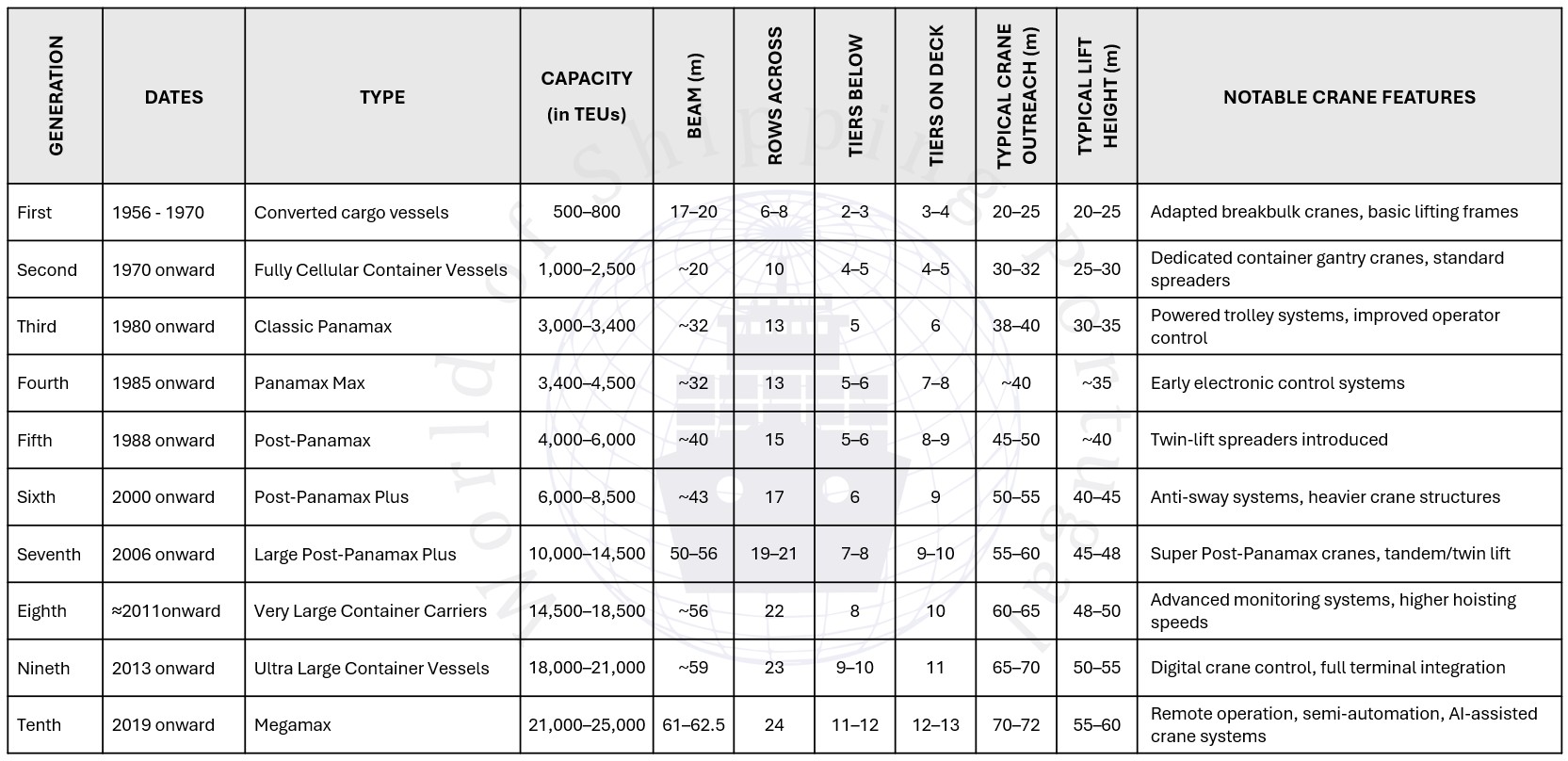
| At the heart of this transformation stands the ship-to-shore gantry crane, an enduring symbol of the mechanised era in maritime logistics. Engineered to lift containers weighing up to 40 tonnes or more and align with shipboard slots, these massive, rail-mounted cranes have dramatically accelerated loading and unloading operations. By reducing vessel turnaround from days to hours and decreasing reliance on manual labour, crane automation has improved planning, enhanced safety, and minimised error rates within terminals. Each successive generation of containerships has driven ports to invest in even larger, more powerful, and technologically advanced cranes, ensuring that handling efficiency keeps pace with maritime innovation. In sum, the evolution of container terminals and the continuous advancement of ship-to-shore cranes (see Table 3 and below) illustrate the scale of infrastructural investment required in the container age and the ongoing adaptation needed to sustain competitiveness in global shipping. |
| |
| 1st Generation (1956–1970): Converted Container Ships. The earliest ship-to-shore (STS) cranes used for container handling were largely adaptations of conventional breakbulk cargo-handling equipment. Outreach was limited, typically 20–25 metres, and lifting heights were modest, reflecting the small dimensions of the first container vessels. These ships generally carried 6–8 container rows across beams of approximately 17–20 metres. Crane operations were relatively simple and container handling remained partly manual, with early spreaders and basic lifting frames. Despite these limitations, the modular nature of containers significantly improved cargo handling efficiency compared with traditional breakbulk operations, reducing loading times and enhancing cargo security. |
| 2nd Generation (1970 onward): Fully Cellular Containerships. The introduction of fully cellular containerships required more specialised container-handling equipment. Vessels in this generation typically carried 10 rows of containers across beams of around 20 metres, with container stacks organised within vertical cell guides. STS cranes evolved into dedicated container gantry cranes, with outreach extending to 30–32 metres and lifting heights capable of servicing four to five tiers on deck. Technological improvements included the widespread adoption of standardised spreaders, improved hoisting mechanisms, and more reliable trolley systems. These developments significantly increased productivity and reduced cargo handling times. |
| 3rd Generation (1980 onward): Classic Panamax Vessels. Classic Panamax vessels were designed to fit the dimensional limits of the original Panama Canal locks and typically carried 13 container rows across beams of approximately 32.3 metres. This increase in vessel width required more powerful cranes with outreach of 38–40 metres and lifting heights approaching 30–35 metres. During this period, STS cranes became standardised pieces of port infrastructure. Powered trolley systems, improved control cabins, and higher lifting capacities enabled faster and safer container handling operations. |
| 4th Generation (1985 onward): Panamax Max Vessels. As Panamax vessels increased in length and container stacking height, crane design also evolved. Although beam remained constrained by canal limits, improved stowage arrangements increased stacking heights to seven or eight tiers on deck.
STS cranes of this period typically required outreach approaching 40 metres and higher lifting heights. Enhanced hoisting speeds and improved operator controls contributed to better productivity. Early digital monitoring and safety systems also began to appear in crane operations. |
| 5th Generation (1988 onward): Post-Panamax Vessels. The emergence of Post-Panamax vessels marked the first major departure from Panama Canal dimensional constraints. Ship beams increased to around 40 metres, accommodating approximately 15 container rows across the vessel. STS cranes capable of servicing these vessels required outreach of 45–50 metres, and crane structures became significantly larger and stronger. This period also saw the introduction of twin-lift spreaders, allowing cranes to handle two containers simultaneously and significantly increasing terminal throughput. |
| 6th Generation (2000–0nward): Post-Panamax Plus. Post-Panamax Plus vessels introduced further increases in vessel size, with beams reaching 43 metres and container configurations of up to 17 rows across. These ships required larger cranes with outreach of approximately 50–55 metres and lifting heights exceeding 40 metres. Crane technology also advanced significantly during this period. Anti-sway systems, improved automation in trolley and hoisting movements, and enhanced structural designs enabled cranes to handle heavier container loads and increased operational speeds. |
| 7th Generation (2006 onward): Large Post-Panamax Plus. Large Post-Panamax vessels further expanded container ship dimensions, with beams reaching 50–56 metres and container configurations of 19–21 rows across the deck. Servicing these ships required the introduction of Super Post-Panamax cranes, with outreach typically between 55 and 60 metres. These cranes were capable of handling nine to ten tiers on deck, often supporting twin-lift and tandem-lift operations. Increasing levels of digitalisation also allowed cranes to be integrated with terminal operating systems (TOS), improving operational coordination within container terminals. |
| 8th Generation (≈2011 onward): Very Large Container Carriers. Very Large Container Ships increased beam to around 56 metres, allowing 22 container rows across the deck. These vessels required even larger STS cranes with outreach of approximately 60–65 metres and lifting heights capable of servicing 10 container tiers above deck. At this stage, crane technology incorporated advanced monitoring systems, higher hoisting speeds, and improved structural stability. Remote diagnostics and improved automation features also began to play a role in terminal crane operations. |
| 9th Generation (2013 onward): Ultra Large Container Carriers. Ultra Large Container Vessels, with beams approaching 59 metres and 23 container rows across, required the deployment of the largest STS cranes yet built. Crane outreach extended beyond 65 metres, with lifting heights typically between 50 and 55 metres under spreader. These cranes were designed to maintain high productivity levels when serving extremely large vessels. Advanced control systems, automated functions, and full integration with terminal operating systems became standard features in major container ports. |
| 10th Generation (2019 onward): Megamax Class. Megamax containerships represent the largest vessels currently operating in global liner shipping. With beams exceeding 61 metres and up to 24 container rows across, they require the most advanced STS cranes in service. These cranes typically feature 70–72 metres of outreach and lifting heights capable of servicing 12–13 tiers on deck and up to 12 tiers below deck. Many modern terminals now operate remotely controlled or semi-automated STS cranes, incorporating artificial intelligence, automated positioning systems, and advanced structural designs to accommodate increasing vessel size and operational complexity. |
|
| |
| Once unloaded, containers are moved to dedicated stacking yards designed for efficient storage, retrieval, and onward movement. These yards are organised by destination, priority, or exit mode (truck, rail, or barge), allowing optimal cargo flow and improved inventory control. The imperative for rapid throughput and minimal dwell times drove the development of on-dock rail connections and intermodal transfer facilities, facilitating seamless movement between maritime and inland transport modes. Such integration proved vital in linking ports to hinterland markets, logistics centres, and industrial zones. |
| |
| Table 3: Ship-to-shore Crane Evolution by Vessel Generation |
 |
| Source: Paixão Casaca (2026) |
| |
| The dramatic increase in container volumes and the globalisation of supply chains also demanded a digital revolution in port administration and planning. The introduction of digitised gate systems and terminal operating systems transformed terminal logistics. These technologies facilitated automated truck appointment scheduling, real-time container tracking, gate-in/gate-out verification, and yard management supported by radio frequency identification (RFID), global positioning systems (GPS), and barcode scanning. As a result, container terminals could optimise traffic flows, reduce bottlenecks, and offer greater operational transparency to shipping lines, freight forwarders, and customs authorities. Modernisation extended beyond equipment and layout: customs procedures and administrative protocols were overhauled to accommodate container movements’ sealed, high-speed nature. Automated tracking and documentation systems became standard, allowing for faster, more reliable clearance and regulatory compliance. |
| Ports that pioneered these innovations, such as Singapore, Rotterdam, Hamburg, Hong Kong, Los Angeles, and Oakland, established themselves as strategic global container hubs. Situated along key maritime corridors and equipped with world-class infrastructure, these ports have been handling millions of TEUs annually and delivering value-added services, including transhipment, customs clearance, storage, and robust hinterland connectivity. Their rise not only catalysed regional economic development and attracted foreign investment but also reinforced their roles as vital nodes in the architecture of globalisation. Conversely, ports that failed to modernise, whether due to financial constraints, labour resistance, or spatial limitations, were rapidly sidelined within the emerging logistics landscape. |
| In essence, containerisation did not merely alter port operations; it transformed ports’ very identity and purpose. From labour-intensive cargo-handling areas, ports evolved into technologically sophisticated, capital-intensive logistics platforms that serve as critical gateways between global supply chains and domestic economies. The container terminal is one of the defining infrastructural innovations of the twentieth century, enabling faster and more reliable trade and reorganising global production and consumption patterns. Beyond this operational and technological transformation, the progressive enlargement of containerships has triggered a cascading transformation across the maritime logistics ecosystem. The implications of vessel size escalation ripple through port planning, network design, environmental governance, and supply chain management. |
| Port polarisation is one of the most immediate and transformative consequences of this escalation in vessel size. The advent of ultra-large container vessels and Megamax ships has fundamentally reconfigured international trade patterns. These vast vessels impose stringent requirements on port infrastructure, necessitating deep draughts, extended berths, reinforced quay walls, high-capacity power supply, and the deployment of state-of-the-art equipment such as dual-lifting ship-to-shore cranes and fully automated yard management systems. Only a select number of ports worldwide have mobilised the substantial investment and long-term planning required to fulfil these technical demands. Examples such as Shanghai, Singapore, Rotterdam, and Algeciras represent this exclusive group, continually expanding and modernising their facilities. These ports have adopted advanced technologies and embraced automation to drive throughput and operational efficiency, establishing themselves as pivotal nodes within an increasingly globalised hub-and-spoke network and serving as primary ports of call for mainline vessel services. Consequently, the rise of the container terminal has engendered a new geography of maritime trade, wherein a relatively small number of highly efficient ports capture a disproportionate share of global container traffic. In contrast, many other ports have experienced relative decline or repositioned themselves towards specialised or niche functions within the broader logistics system. |
| Port polarisation not only signifies the increasing dominance of a small number of core ports but also amplifies the tendency of mainline services to concentrate their calls at these facilities, resulting in a self-reinforcing effect: major shipping joint services prioritise these locations in their network design, attracting greater investment in infrastructure, logistics parks, and value-added services, and creating powerful regional economic engines. This dynamic simultaneously creates a stark dichotomy between core and peripheral ports. While core ports thrive, attracting international cargo flows, investment, and high-value economic activity, smaller or less developed ports often struggle to keep pace. Lacking the capital or the cargo volumes to justify significant upgrades, these ports are frequently relegated to supporting roles within the network. They function as feeders, relying on smaller vessels to connect their hinterlands to the main global arteries, or in some cases, find themselves bypassed altogether as shipping lines consolidate routes to maximise economies of scale. The process of port polarisation thus leads to a centralisation of global trade flows, funnelling an increasing share of container traffic through a small number of strategic gateways. This concentration magnifies these select ports’ geopolitical and economic significance, bestowing them substantial influence over regional supply chains and even global trade patterns. At the same time, it introduces new vulnerabilities into the system: congestion, labour actions, or infrastructure failures at one of these core nodes can have cascading effects throughout the global supply chain. |
| Ultimately, port polarisation is both a symptom and a driver of the structural realignment underway in maritime logistics, shaping the geography of global commerce in profound and lasting ways. The arrival of each new generation of ultra-large container vessels brings with it increased carrying capacity and an exponential rise in the operational demands placed on ports and their associated hinterland networks. One mega-ship alone can unload or load over 10,000 containers in a single port call, placing significant demands on terminal capacity, equipment, and coordination. This sudden, concentrated influx of cargo creates immense pressure on landside operations, requiring terminal operators to orchestrate a finely tuned choreography of labour, equipment, and systems. Within the terminal itself, multiple ship-to-shore cranes must work in perfect synchrony to achieve the fast, efficient transfer of containers between vessel and yard. Stacking strategies become increasingly complex as thousands of boxes must be organised by destination, priority, and mode of onward transport, all while minimising unnecessary moves and yard congestion. The need to optimise every moment of berth time has ushered in a new era of precision scheduling and data-driven operations. Any inefficiency can result in costly delays for the vessel in port and the tightly interlinked global shipping schedules on which supply chains now depend. |
| Terminals have rapidly adopted sophisticated digital systems to manage these heightened operational demands. Terminal operating systems enable real-time container flow planning, monitoring, and coordination. Technologies such as optical character recognition and the Internet of Things are deployed to automate gate processes, track container movements, and enhance yard optimisation. These systems work together to provide the real-time visibility and predictive capability necessary to avoid bottlenecks, smooth out traffic peaks, and reduce error rates. However, the challenges extend well beyond the port perimeter. The hinterland, comprising the road, rail, and inland waterway networks that connect ports to regional and national markets, must also absorb these massive, periodic surges in container volume. If the flow of containers from port to inland destinations becomes bottlenecked, urban congestion, shipment delays, and spiralling logistics costs can quickly result. This has driven investment in advanced hinterland logistics solutions, such as double-stack rail corridors, expanded intermodal terminals, and strategically located inland ports and freight villages. These facilities serve as buffer zones, allowing for the rapid dispersal, storage, and redistribution of containers while helping to mitigate the risk of urban congestion and enhance supply chain resilience. |
| As a result of this consolidation of vessel calls, fewer in number but far larger in scale, the stakes of operational disruptions are now higher than ever. The costs of delays, whether due to weather, labour actions, or technical issues, can cascade throughout the supply chain, affecting multiple carriers, shippers, and, ultimately, consumers, as witnessed in the Los Angeles/Long Beach ports during the COVID-19 pandemic. This reality reinforces the critical importance of real-time coordination, digital integration, and predictive logistics planning in the contemporary maritime landscape. Only by leveraging advanced technology and continuous process innovation can ports and hinterland networks keep pace with the demands of the mega-ship era. |
| Moreover, the escalation in containership size has triggered a fundamental restructuring of maritime service patterns. Driven by the economies of scale achieved with mega-containerships, ocean carriers have increasingly rationalised their networks, reducing the number of direct ports’ calls in favour of concentrating mainline services at a smaller set of strategically located mega-hubs. This evolution has led to the widespread adoption of the hub-and-spoke model, in which large mother vessels operate between global hubs while smaller feeder vessels shuttle containers to and from regional and secondary ports. This strategic realignment has far-reaching implications. One immediate outcome is a marked surge in transhipment volumes at major hub ports, fuelling demand for efficient short-sea shipping services and robust intermodal connections to the hinterland. While this enables carriers to achieve greater vessel utilisation and cost efficiency, it also significantly increases operational complexity. Maintaining the integrity of delivery schedules now depends on the seamless synchronisation of multiple service legs, tight coordination between carriers, ports, and inland transport operators, and high levels of real-time visibility across the network. |
| Still, a key vulnerability of the hub-and-spoke paradigm is its reliance on a limited number of mega-hub ports. The repercussions cascade across the entire supply chain when these pivotal nodes experience congestion, labour actions, or disruptions. Bottlenecks at transhipment hubs can delay cargo well beyond the port as downstream feeder services and inland transport links await the arrival of mother vessels. This concentration of flows magnifies risk even as it enhances efficiency, making digital coordination, predictive analytics, and collaborative platforms indispensable tools for modern carriers. In response to these and many other challenges, container shipping companies are deploying an increasingly sophisticated and diverse portfolio of service options. Expanding operations in the container sector now involves more than simply adding ships or new trade lanes; it requires a strategic assessment of service models and operational configurations that best align with market objectives, network geography, customer needs, and available resources. Each service type offers distinct advantages and trade-offs regarding cost efficiency, transit time, flexibility, and market coverage. Besides the traditional hub-and-spoke (mother and feeder vessels), the available service options shaping today’s container shipping networks include: |
| |
- End-to-End Services: Direct sailings between origin and destination ports, minimising transhipment and ensuring fast, reliable delivery on high-volume corridors.
|
- Pendulum Services: Vessels travel in a loop that links multiple major ports across two or more trade lanes, offering flexible connections and operational efficiency.
|
- Triangular Services: Ships follow a triangular route connecting three main regions or ports, often balancing export and import flows and maximising utilisation.
|
- Round-the-World Services: Vessels operate a continuous global circuit, calling at key ports on several continents, which is ideal for connecting global trade flows and balancing equipment.
|
- Double-Dipping Services: Ships call at the same port twice within a single loop, allowing additional loading/unloading opportunities and operational optimisation.
|
- Relay Services: Containers are transferred between different mainline services at an intermediate hub, enabling flexible routing and connecting disparate trade lanes.
|
- Interlining Services: Cargo is transferred between carriers or alliances, offering broader network coverage and service frequency.
|
- Joint Services: Two or more carriers cooperate on shared vessel operations, pooling capacity and harmonising schedules to optimise efficiency and customer service.
|
|
| |
| The selection and combination of these service options allow container shipping lines to adapt to fluctuating demand, optimise asset utilisation, minimise operational costs, and provide tailored solutions to shippers with diverse needs and geographic requirements. In the broader framework of multimodal logistics, the strategic deployment of these service models directly influences the supply chain’s efficiency, resilience, and reliability. As the industry continues to digitalise and embrace advanced technologies, success will increasingly depend on the intelligent design of these service networks, balancing scale with agility, coverage with reliability, and cost with customer satisfaction. The following sections provide a detailed examination of each key service option, with practical examples illustrating their application in real-world transport scenarios and their impact on modern global supply chains. |
| |
| 6.3. The Inland Extension of Containerisation |
| Therefore, and from a multimodal perspective, containerisation was not merely a maritime revolution but a catalyst for comprehensive change across inland transport systems. By the 1980s and 1990s, the logic of standardised, intermodal transport began to profoundly reshape inland logistics systems, ushering in an era of deep integration between rail, road, and inland infrastructure. As global trade volumes soared and inland industrial activity intensified, the seamless movement of containers beyond port boundaries became both a logistical necessity and a competitive advantage. The pursuit of seamless intermodal connectivity, whereby containers could travel uninterrupted across ships, trains, and lorries, necessitated an unprecedented reconfiguration of rail and road operations, equipment, and supporting administrative frameworks. |
| On the railways, the transformation was structural and far-reaching. Traditional wagon fleets, built for loose or palletised cargo, were gradually replaced by rolling stock specifically designed for container transport. Flatcars and later well wagons were engineered to securely hold containers, reducing the risk of load shift during high-speed travel and shunting. Among the most significant advancements in inland container transport was the introduction of double-stack container trains, first implemented in the United States in the 1980s. This innovation enabled two ISO containers to be stacked vertically on specially designed railcars, doubling the carrying capacity per train without increasing train length or requiring additional locomotives. In North America, the adoption of double-stack well wagons proved particularly impactful, as it made it possible to transport two containers within the existing loading gauge, delivering substantial cost and energy savings per TEU moved. This development strengthened the competitiveness of rail in long-haul corridors. Railways upgraded loading terminals, track alignments, and clearance profiles to accommodate double-stack trains’ increased height and weight, reflecting a comprehensive approach to intermodal integration. |
| However, the impact of double-stacking on rail freight operations was multifaceted. The introduction of double-stack container trains brought with it substantial infrastructure requirements. Achieving double-stack operations necessitated significant adjustments across the railway network, including higher tunnel clearances, reinforced bridges, and the reconfiguration of terminals to accommodate double-stacked trains’ increased height and weight. These changes represented massive capital investment by rail operators and public authorities, who recognised the long-term value of enabling this transformative technology. From an operational perspective, double-stacking profoundly enhanced efficiency within the rail freight sector. Allowing more containers to be moved per train reduced the cost per container mile and increased overall asset utilisation. This operational advantage significantly improved rail’s competitiveness against long-haul trucking, particularly on coast-to-inland routes where economies of scale could be fully realised. Moreover, double-stack rail brought marked environmental benefits. Its ability to move a greater cargo volume per train resulted in higher energy efficiency and lower emissions per TEU, positioning double-stack rail as a more sustainable option for inland cargo movement. These combined operational and environmental advantages have made double-stack rail integral to modern, sustainable intermodal transport systems. Today, double-stack rail is a cornerstone of intermodal logistics in North America, serving major corridors such as the Los Angeles–Chicago–New York axis and increasingly influencing rail development strategies in other container-heavy economies like India and China. |
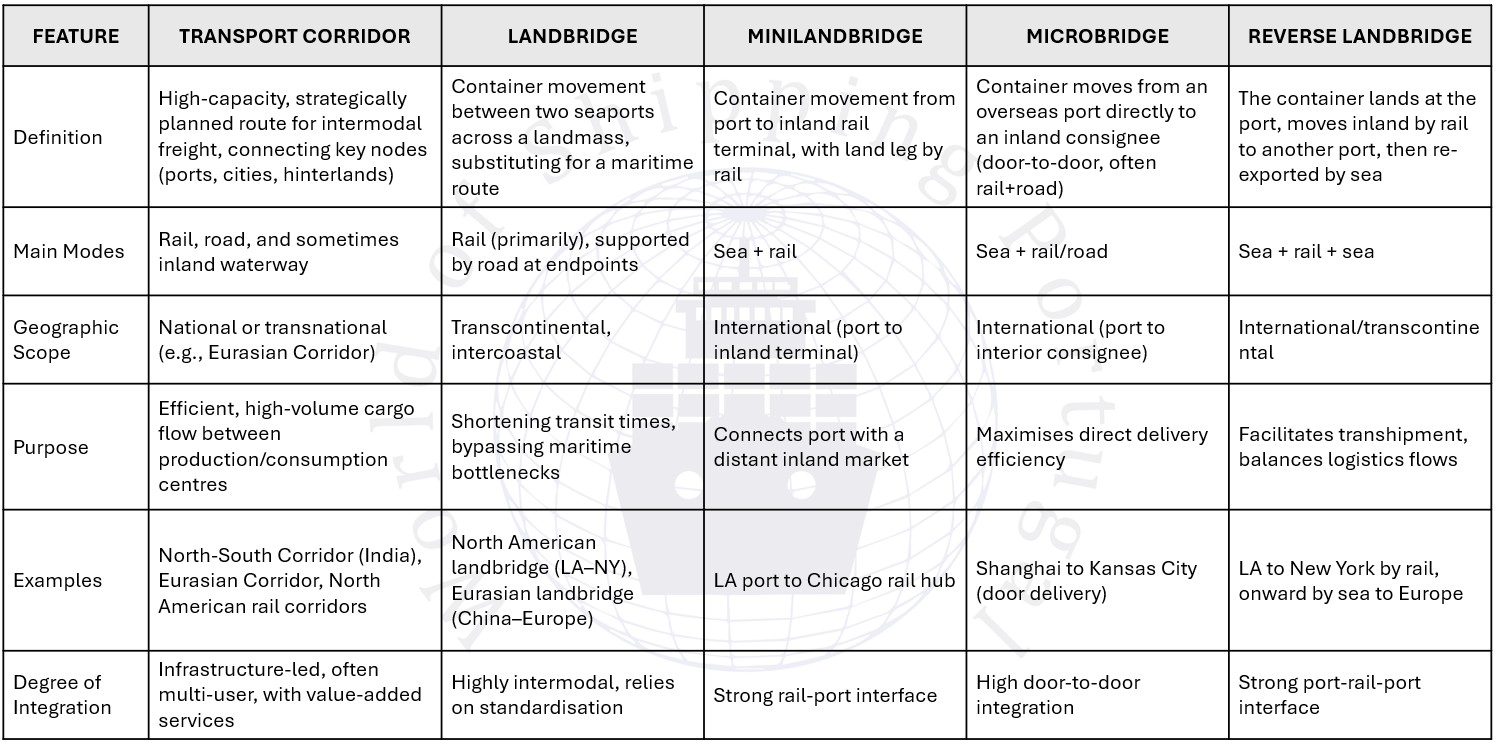
| The concept of the transport corridor has become fundamental in the organisation and management of modern logistics and trade. A transport corridor refers to a high-capacity, strategically planned route, often combining multiple modes of transport, such as rail, road, and sometimes inland waterways, that efficiently connects major economic centres, seaports, and hinterland regions. Corridors are typically anchored by dedicated, upgraded infrastructure, such as double-track railways, high-capacity highways, intermodal terminals, and logistics parks, which together support the rapid and reliable movement of goods and, in many cases, passengers as well. However, the significance of a transport corridor goes beyond physical infrastructure: successful corridors are also underpinned by harmonised regulatory frameworks, simplified customs procedures, and cross-border agreements that facilitate transit and reduce administrative barriers. In advanced corridors, value-added logistics services, such as warehousing, consolidation, and customs clearance, are increasingly co-located at nodal points, supporting supply chain agility and integration. |
| Transport corridors play a crucial role in regional economic development by reducing transit times, lowering transport costs, and enhancing access to international markets for landlocked or peripheral areas. They foster clustering effects, attracting investment in manufacturing, distribution, and related services along their length. Globally, prominent examples include the North American rail corridors, which link ports on the Pacific, Atlantic, and Gulf coasts with inland markets and industrial hubs, and the Eurasian rail and road corridors, which connect the vast economies of China and Europe via Russia and Central Asia, notably as part of the Belt and Road Initiative. Other examples, such as the Northern Corridor in East Africa or the North-South Corridor in India, further illustrate how corridor development is central to national and transnational logistics strategies. While corridors support various freight flows, including bulk, breakbulk, and containerised cargo, they are increasingly designed with intermodal integration in mind, enabling seamless transitions between modes and positioning themselves as indispensable arteries of global trade. |
| Within such corridors, the landbridge model describes a specific type of intermodal operation: the overland movement of maritime containers between two seaports located on different coasts, typically as a substitute for an all-water shipping route. A landbridge is an intermodal logistics operation in which containers are transported by rail (less commonly, by road) across a landmass, linking two maritime ports and creating a continuous, high-speed route between ocean shipping lanes. In a landbridge operation, containers arriving by sea at one port are transferred directly onto rail or road transport and then moved across an entire continent before reloading onto a vessel at the destination port for onward maritime shipment. For example, the classic North American landbridge uses the continent’s high-capacity rail corridors to move containers swiftly between Pacific ports such as Los Angeles or Long Beach and Atlantic or Gulf ports such as New York or Houston, bypassing longer maritime routes through the Panama Canal. Similarly, the Eurasian landbridge leverages upgraded transcontinental rail infrastructure to connect the ports of eastern China with major European ports, offering a faster alternative to ocean transport via the Suez Canal. |
| The key distinction is that landbridges are defined by their function, serving as high-speed, high-capacity conduits for containerised maritime trade across landmasses. In contrast, transport corridors are defined by physical and organisational characteristics and may support a wide range of freight types, passenger traffic, and regional economic development objectives. Not every transport corridor is operated as a landbridge; only those designed and marketed for through-container flows between seaports, typically with harmonised schedules, customs facilitation, and intermodal efficiency, qualify as true landbridges. The landbridge concept, therefore, is fundamentally about logistics integration and time-sensitive global supply chains, using the infrastructure of transport corridors to create a viable overland alternative to traditional maritime shipping routes. Additional landbridge variants include: |
| |
- Mini-landbridge: A mini-landbridge refers to the movement of cargo arriving by sea at a coastal port, then transported inland by rail across the continent, with the final delivery to an inland point rather than another port. This arrangement involves only one ocean leg and a single land crossing, directly connecting the coastal entry point with an inland market. For instance, cargo arriving at the Port of Los Angeles from Asia may be transported by rail to Chicago, where it is delivered to the consignee, thus bypassing a second sea leg.
|
- Microbridge: A microbridge service integrates an ocean voyage with inland rail transport, moving a container directly from a coastal port to a final inland destination or vice versa, all under a single-through bill of lading. This model streamlines logistics by eliminating intermediate handling and allows the shipper or consignee to manage the entire journey as a unified transaction. For example, a container shipped from Shanghai arrives at the Port of Los Angeles and then travels by rail directly to Kansas City, reaching the consignee without additional transfers.
|
- Reverse Landbridge: A reverse landbridge describes the process by which cargo arrives by sea at an East Coast port and is subsequently transported inland by rail to its final destination. This pattern is commonly used when shipping from Asia via the Panama Canal to reach inland markets in North America. For example, goods from Asia are shipped to the Port of New York and then moved by rail to Chicago, completing the journey with only one ocean leg followed by a substantial land segment.
|
|
| |
| Table 4 compares transport corridors and the landbridge concepts. |
| |
| Table 4: Transport Corridors vs Landbridge Concepts |
 |
| Source: Paixão Casaca (2025) |
| |
| The widespread adoption of ISO-compliant chassis and skeletal trailers similarly transformed road haulage. Before containerisation, trucking operations were hampered by the diversity of cargo units and the inefficiencies of breakbulk handling. The move to standard containers meant specialised trailers could quickly and securely move units between ports, rail terminals, warehouses, and final destinations. The modularity and durability of containers reduced the need for repacking or trans-loading. At the same time, the extensive reach of trucking networks provided critical first and last-miles connectivity, linking the hinterland to the global maritime system. This flexibility proved vital in dispersed industrial regions, where rail connections might not be readily available. |
| Many countries developed inland container depots and dry ports to support transport operations, bringing logistical services closer to inland production and consumption centres. By repositioning container flows inland, inland container depots helped decongest port areas, optimise cargo routing, and support hinterland trade development, especially in landlocked or remote regions. These facilities act as functional extensions of maritime terminals, replicating key services such as customs inspection and clearance, transhipment and consolidation, and container storage and maintenance. As a result, inland container depots and dry ports have become vital nodes within the wider intermodal logistics network, enabling more efficient and flexible management of container flows well beyond the traditional port perimeter. These facilities function as functional extensions of maritime terminals, replicating key services such as customs inspection and clearance, allowing import/export formalities to be completed inland, transhipment and consolidation, supporting multimodal handoffs between rail, road, and local distribution networks and container storage and maintenance, reducing the dwell time of equipment at coastal ports. |
| Further inland freight villages and intermodal logistics hubs have emerged as strategic nodes within the global container network. These purpose-built facilities are typically situated near industrial clusters, highway intersections, or major railway junctions, and they are designed to handle high volumes of containerised cargo. They offer integrated warehousing and distribution centres, direct rail spurs, convenient road access, and services such as inventory management, cross-docking, and other value-added logistics functions. Such nodes play a critical role in regional supply chain orchestration, serving as staging grounds for last-mile delivery or as points of origin for export-bound freight. By enabling logistics operators to consolidate cargo flows, optimise route planning, and support just-in-time and lean manufacturing systems, they significantly enhance the efficiency and flexibility of modern supply chains. |
| Administrative and regulatory innovations evolved in parallel. The transition to containerised logistics necessitated new customs clearance, inspection, and documentation protocols. The sealed nature of containers made traditional cargo verification and tallying obsolete, driving the adoption of automated tracking, electronic data interchange, and real-time visibility systems. These advancements expedited border crossings and terminal throughput. They enhanced the security and traceability of goods, critical factors in a globalising economy where supply chain risk and compliance were of growing concern. |
| The cumulative effect of these innovations was the emergence of an integrated, truly global logistics system. Railways and trucking companies, equipped with container-specific assets and supported by digital administration, became vital partners in the intermodal chain. Their ability to deliver door-to-door services, linking exporters, importers, and consumers across continents, was a defining achievement of containerisation. This extended the benefits of speed, reliability, and cost-effectiveness far beyond the quayside. In this way, the transformation of inland transport systems, the development of strategic corridors, and the proliferation of landbridge models stand as central pillars in the ongoing evolution of global supply chains. |
| From a sustainability perspective, the dramatic escalation in containership size has brought notable environmental efficiencies and introduced new and complex sustainability dilemmas. On the one hand, larger vessels offer remarkable fuel efficiency and lower emissions per container transported, primarily due to economies of scale. By carrying thousands of TEUs in a single voyage, these ships reduce the overall fuel consumption and greenhouse gas emissions associated with each cargo unit, thereby supporting the decarbonisation of global logistics chains. However, these global gains in efficiency come with a suite of localised environmental trade-offs. One pressing concern is the concentration of emissions in and around the world’s largest ports. As ever-larger vessels cluster their calls at a select few mega-hubs, they generate significant volumes of exhaust gases, including sulphur oxides, nitrogen oxides, and particulate matter, all of which contribute to air quality degradation and can negatively affect community health in adjacent urban areas. In addition, the underwater noise pollution generated by massive, slow-moving ships presents a growing threat to marine life. The low-frequency noise these vessels emit can disrupt the behaviour and migration patterns of whales, dolphins, and other sensitive marine species, particularly in busy shipping lanes near major ports. |
| Port operations themselves face environmental pressures as a direct result of vessel scale. Accommodating the unloading and reloading of thousands of containers in a short time frame requires powerful cranes, extensive lighting, and expansive storage areas, all of which demand significant energy input. Unless offset by renewable sources or energy-saving measures, this increased consumption further amplifies the carbon footprint and strains local power grids. A paradox thus confronts the maritime industry: while vessel size escalation delivers global efficiency gains, it intensifies local environmental externalities, forcing ports and regulators to reconcile conflicting priorities. |
| In response, authorities and industry actors have introduced various regulatory and technological measures. The IMO 2020 sulphur cap and the European Union’s Emissions Trading System for shipping aim to curb the emission of harmful pollutants, while initiatives such as green shipping corridors, shore power electrification (allowing ships to plug into the grid and shut down engines while berthed), and the adoption of alternative fuels like liquefied natural gas, methanol, or ammonia represent promising pathways toward a more sustainable maritime sector. Nevertheless, the challenge remains dynamic and ongoing. The true sustainability of vessel size escalation will ultimately depend not only on technological innovation but also on the ability of ports, shipping lines, and regulators to balance global efficiency with local environmental stewardship, ensuring that the pursuit of scale does not come at the expense of the communities and ecosystems most directly impacted by maritime trade. |
| The inland extension of containerisation catalysed a series of paradigm shifts that continue to shape global logistics today. Among the most significant was the rise of just-in-time manufacturing. With reliable container flows connecting ports to factories, firms could synchronise inbound deliveries with production schedules, thereby minimising the need for costly buffer inventories. This reduced working capital requirements and supported more agile and responsive manufacturing models. |
| Geographically, the development of inland container hubs diminished reliance on congested port cities and made it possible for industry to expand into interior regions. Lower real estate and labour costs in these locations encouraged decentralised industrial growth, allowing firms to optimise their operating expenses and access national and regional markets. The emergence of diversified inland logistics networks also bolstered supply chain resilience. With alternative routing options in place, companies could respond more flexibly to disruptions at ports, whether caused by labour actions, extreme weather, or infrastructure failures, thereby safeguarding the continuity of their global operations. |
| The advent of containerisation triggered a profound reorganisation of global economic geography. As the ISO container established itself as the standard transport unit, the distance, cost, and complexity barriers in international trade were dramatically reduced. The immediate effect was a sharp decline in maritime transport costs; shipping expenses fell by as much as 90% compared to traditional breakbulk cargo. At the same time, containerisation brought new levels of predictability and reliability to the logistics chain. Transit times became far more predictable as vessel turnaround times at ports dropped and manual cargo handling was minimised. Cargo damage, pilferage, and misrouting were sharply reduced thanks to sealed, trackable units. Lower labour costs at ports and improved vessel utilisation further contributed to the economic viability of long-distance trade. |
| These changes made it feasible for companies to decentralise production and globalise procurement, leading to the emergence of complex, integrated supply chains. As the cost and uncertainty of moving goods across oceans declined, firms began configuring their operations around comparative advantage, embracing multi-country production models. Raw materials might be sourced in Africa, components manufactured in China or Vietnam, and final assembly performed in Mexico or Eastern Europe before goods are shipped to consumers in North America or the European Union. This strategic fragmentation of the value chain enabled multinational firms to optimise for cost, speed, and market proximity rather than being bound by the location of natural resources or end markets. The modular, scalable nature of container shipping made such global sourcing and production on an unprecedented scale both feasible and efficient. |
| East and Southeast Asia stand as the greatest beneficiaries of the container revolution. The development of global supply chains directly supported the industrialisation of countries such as South Korea, Taiwan, Singapore, and China. These nations invested heavily in deep-water container ports capable of accommodating Post-Panamax and, later, ultra-large container vessels, export processing zones, bonded logistics parks, and modern road and rail connections to the hinterland. State-supported infrastructure, including highways, railways, and inland distribution centres, provided the backbone for export-led growth. As a result, these countries became manufacturing powerhouses, producing a vast array of goods for the world market. Container throughput soared, with ports like Shanghai, Singapore, Busan, and Shenzhen consistently ranking among the busiest globally, each handling tens of millions of TEUs yearly. |
| |
| 6.3. Technological Advancements and Digitalisation |
| While the physical standardisation of containers revolutionised global trade in the twentieth century, the twenty-first century has ushered in a new era defined by digital technologies, automation, and intelligent systems. Today’s containerised supply chains are faster, more cost-effective, and increasingly smart, connected, and data-driven. This transformation reflects the mounting complexity of global logistics and the demand for greater visibility, precision, and efficiency. |
| A prime example of this evolution is the advent of smart containers, which have transformed traditional steel boxes into digital assets. These containers have Internet of Things devices, allowing continuous data collection and transmission throughout the cargo journey. GPS tracking now provides real-time location updates, significantly enhancing supply chain visibility and reducing the risks of misrouting or theft. Environmental sensors monitor temperature, humidity, shock, and light exposure, vital for sensitive cargo such as pharmaceuticals, electronics, or perishable foods. In addition, integrating RFID and quick response (QR) code technologies facilitates automatic identification, inventory validation, and seamless interaction with warehouse management systems. Sensor data also enables predictive maintenance, allowing analytics platforms to detect anomalies and pre-empt container servicing needs, thus reducing operational downtime. Through these advances, smart containers have shifted from passive cargo units to active information nodes capable of autonomously communicating their status and condition across global logistics networks. |
| Parallel to these developments, automation in container terminals has fundamentally changed the nature of port operations. The most advanced terminals, such as Rotterdam’s Maasvlakte II and Shanghai’s Yangshan Deep-Water Port, combine mechanical precision with software intelligence to optimise yard operations. These facilities deploy autonomous vehicles, robotic cranes, and integrated terminal operating systems, managing container flows with remarkable accuracy and efficiency. Automation has delivered multiple benefits, including higher throughput, round-the-clock operational capacity, and enhanced safety by reducing human exposure to hazardous environments. Consistent performance, free from fatigue or shift changes, and lower emissions through energy-efficient equipment have further contributed to sustainable and reliable port operations. Leading Los Angeles and Hamburg terminals have similarly adopted such technologies to accommodate growing volumes while reducing reliance on manual labour. |
| Beyond the physical infrastructure, digital supply chain platforms have emerged as critical enablers of coordination and intelligence. These platforms consolidate data from shipping lines, terminal operators, customs authorities, and logistics providers, creating unified dashboards for end-to-end cargo management. With capabilities ranging from real-time tracking and exception management to demand forecasting and route optimisation, these platforms harness artificial intelligence and machine learning to predict disruptions and recommend the most efficient pathways. Integrating blockchain-based documentation systems ensures secure, tamper-proof handling of bills of lading, manifests, and certificates. Industry-leading platforms such as TradeLens, CargoSmart, and project44 exemplify the new standard for multimodal logistics management, fostering greater agility, resilience, and transparency in supply chain operations. |
| These technological advancements represent more than incremental improvements; they mark a strategic shift in containerisation. The industry is moving from manual to autonomous operations, static to dynamic planning, and reactive to predictive management. Data, once siloed across different stakeholders, is increasingly integrated to deliver holistic supply chain visibility. These tools are vital in equipping shippers and logistics providers with the resilience and adaptability needed to navigate uncertainty in an era characterised by disruptions, whether due to pandemics, geopolitical tensions, or climate-induced port closures. |
| The digitalisation of container shipping signals the next frontier in global logistics. By fusing physical infrastructure with digital intelligence, contemporary container systems offer enhanced movement of goods and deeper insight, control, and adaptability. As technologies such as artificial intelligence, blockchain, and the Internet of Things mature, containerisation will become synonymous with synchronisation, sustainability, and strategic foresight, ensuring relevance in an increasingly complex and interconnected world. |
| |
7. Future Directions in Containerisation |
| The evolution of containerisation reflects a dramatic transformation in global logistics over two centuries. In the early 1800s, cargo was handled manually in loose forms, requiring intensive labour at ports and depots. The late nineteenth century introduced wooden pallets and mechanised equipment, gradually improving efficiency. By the early twentieth century, lift vans and the first small standard containers enabled rudimentary intermodal transfers, further advanced by the standardisation efforts of British and European railways and the founding of the International Container Bureau in 1933. World War II spurred further innovation, with the U.S. military’s experiments leading to the development of the CONEX box in 1950, a precursor to commercial containerisation. The first true container ship voyage in 1956 marked the start of a global revolution, soon solidified by adopting ISO container standards in the 1960s. The 1970s and 1980s saw the worldwide spread of container ports, the rise of mega-ships, and double-stack rail services, greatly expanding capacity and efficiency. From the 1990s, containerisation became central to just-in-time logistics and the globalisation of trade (see Figure 9). |
| |
| Figure 9: Containerisation Timeline, 1770s - 2030 |
 |
| Source: Wikipedia (2025) |
| |
| As McLean’s containerisation vision approaches its eighth decade, the industry is undergoing one more transformation driven by the imperatives of resilience, sustainability, technological advancement, and inclusivity. While containerisation has revolutionised global freight transport, it now faces various contemporary challenges, actively reshaping its evolution and future trajectory. The twenty-first century has been characterised by rapid digitalisation, with RFID, GPS, smart containers, and automation reshaping operations. |
| The COVID-19 pandemic exposed the vulnerabilities embedded within globally integrated container networks, prompting the industry to reimagine its operational models. In the future, supply chains will likely be designed with resilience as a core principle. Firms are already diversifying sourcing strategies, adopting onshoring and nearshoring, and establishing strategic inventory buffers to mitigate risks associated with global shocks. Overland routes and secondary ports are being actively developed to ensure greater redundancy and flexibility. The drive for adaptability will define new logistics strategies, reducing dependency on just-in-time models and fostering a more balanced global flow of goods. |
| Environmental sustainability is now at the forefront of container shipping’s evolution. In response to mounting regulatory and societal pressures, the industry invests heavily in decarbonisation technologies, such as alternative fuels, liquefied natural gas, green methanol, hydrogen, and low-emission propulsion systems, including hybrid and electric vessels. Operational measures, such as slow steaming and advanced route optimisation, are being widely adopted to curtail emissions. As these trends accelerate, the future of containerisation will be characterised by continual innovation in green technologies, tighter integration with circular economic practices, and a proactive approach to meeting ever-stricter environmental standards. Sustainable container flows, modular packaging, and reverse logistics systems will become essential components of a circular supply chain, reducing waste and emissions while maximising resource efficiency. |
| Container logistics is undergoing a digital revolution, with advanced technologies fundamentally reshaping supply chain operations. The widespread adoption of smart containers outfitted with sensors and real-time tracking capabilities will provide unprecedented end-to-end visibility, making it possible to anticipate disruptions before they occur. Integrating artificial intelligence, blockchain, and the Internet of Things will drive efficiency gains across customs, inventory management, and cargo routing. At the same time, digital twins will support predictive maintenance and dynamic risk management. However, as digitalisation deepens, the industry must address new cybersecurity challenges by investing in robust, multi-layered defences and resilient IT infrastructure, ensuring data integrity and operational continuity. |
| Automation and artificial intelligence are rapidly changing the landscape of terminal operations and hinterland logistics. While these innovations promise significant productivity gains and cost reductions, they raise pressing questions about workforce displacement and social equity. Therefore, the future of containerisation must include strategies for workforce reskilling, fair transition policies, and equitable access to technological advancements. In parallel, addressing the disparities between advanced mega-ports and less developed facilities remains a priority. Investment in infrastructure, skills, and technology in emerging regions will be essential to ensure that the benefits of containerisation are broadly shared and that global trade remains inclusive. |
| Geopolitical realignments and changing economic power dynamics are prompting the reconfiguring of global trade routes. Nearshoring, friend-shoring, and the decentralisation of manufacturing are driving growth in regional supply chains, particularly in Southeast Asia, South Asia, Latin America, and Africa. Ports and logistics hubs in these regions are being upgraded to handle higher container volumes and integrated with new intermodal corridors. This spatial reorganisation will likely result in a more multipolar global economy, where containerisation enables the flexible and resilient movement of goods across diverse regions and markets. |
| The steel container, once a simple solution to transport inefficiency, has evolved into the backbone of global trade. However, its future significance will depend not merely on scale or cost but on its ability to adapt to a rapidly changing world, one defined by digital innovation, environmental responsibility, supply chain resilience, and equitable access to opportunity. Looking ahead to 2030, the focus is shifting toward decarbonisation, green corridors, and AI-driven optimisation, ensuring that containerisation continues to adapt to the demands of a sustainable, intelligent global economy. As the contours of the global economy continue to shift, containerisation will remain both a catalyst and a mirror of transformation, continually redefining what is possible in international logistics. |
| |
References |
| Maersk Line (2012). Malcolm McLean at railing, Port Newark, 1957. Wikimedia Commons. Retrieved from https://commons.wikimedia.org/w/index.php?curid=27640875 [accessed 09 June 2025]. |
| |
Note |
| This text was simultaneously published on LinkedIn. |
| |
About the Author |
| Ana Casaca was, first and foremost, a Deck Officer responsible for navigational watches. Being at sea gave her a thorough perspective of the operational side of the shipping industry. She holds a B.Sc. (Honours) in Management and Maritime Technologies from Escola Nautica Infante D. Henrique (Portuguese Nautical school), an MSc in International Logistics from the University of Plymouth and a PhD in International Transport/Logistics from the University of Wales-Cardiff. Next, she became an Experienced Lecturer, Researcher and Peer Reviewer in Maritime Economics and Logistics. In between, numerous functions and roles. For 20 years, she has been an External Expert for the European Commission, evaluating R&D/CEF proposals within the scope of maritime transport. In parallel, she has carried out other projects. She has delivered training and has been invited, since 2002, to peer review academic papers submitted to well-known international Journals. She is the author of several research papers published in well-known academic journals and member of some journals’ editorial boards, namely, Maritime Business Review Associate Editor, Journal of International Logistics Editorial Board Member, Universal Journal of Management Editorial Board Member, Frontiers in Future Transportation Review Editor, and Journal of Shipping and Trade Guest Editor. She is also the founder and owner of ‘World of Shipping Portugal’ a website initiative established in 2018 focused on maritime economics. In addition, she is a Member of the Research Centre on Modelling and Optimisation of Multifunctional Systems (CIMOSM, ISEL), Fellow of the Institute of Chartered Shipbrokers (ICS) and Member of the International Association of Maritime Economists (IAME). Beyond my professional achievements, she is deeply committed to holistic well-being and creative expression. She is an avid practitioner of Yoga, Pilates, and Tai Chi/Chi Kung, and a passionate traveller with a keen appreciation for the arts. Her interests extend to sewing and the sensory world of scents, which she explores by creating crafted cosmetics. This passion for creativity and mindful living led her to found Earth & Soul, a project devoted to wellness, artistic expression, and soul-nourishing content to pursue a meaningful and balanced life. All these elements bring her on the quest for creativity, always with the expectation of doing something extraordinary! |
| |
| This work was written from the core and refined with intellect. It stands as a contribution of lived experience, conscious thought, and unwavering clarity. |
| |
|
| |
| Top of the page |
| |
|
|